


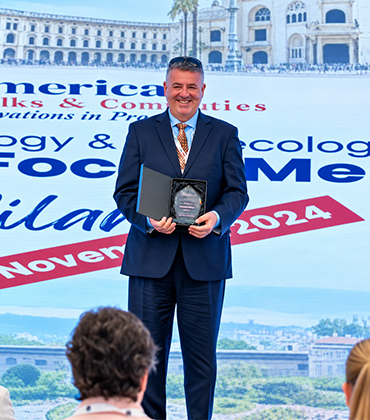
 Randy Beimel, President
Three Trends Shaping the Field
The first is precision. Regenerative medicine is moving away from "inject and hope" toward image-guided, diagnosis-first care. Ultrasound now sits at the centre of how good physicians work. At our RMOS summit in Tokyo this year, the ultrasound master class filled the room with people standing outside, and the final day was a full hands-on bootcamp with nine stations. Physicians understand that a biologic placed in the wrong structure is wasted, and that many patients who arrive after years of failed treatment were never correctly diagnosed to begin with.
The second is the move to autologous, point-of-care treatment. PRP, bone marrow concentrate, fat-derived and blood-derived products all start from the patient's own tissue and are prepared at the bedside. This is where much of the device innovation is happening, and in our experience the best ideas come from clinicians. All three of our proprietary devices grew out of collaboration with physicians in our own network.
The third is that patients are willing to travel. In June, our Centre of Excellence in Belgrade treated eleven patients from six countries in a single day. These were people who could not find the right specialist at home and chose to cross borders rather than keep waiting.
The Challenges We Cannot Ignore
The biggest obstacle is training. A lecture can explain a technique, but it cannot teach a physician where a needle belongs. That is why our societies put so much weight on live demonstrations, cadaver labs and small-group teaching. Adoption will only grow as fast as competence does.
The second is access and cost. Many regenerative procedures still sit outside insurance coverage. Physicians are often uncomfortable explaining unfamiliar treatments or discussing out-of-pocket costs, and patients are left to sort through online claims alone. This is where the field is most exposed.
Overpromising damages trust for everyone, and responsible patient selection, including telling a patient when they are not a good candidate, is part of the treatment.
The third is regulation. In Europe, the new SoHO Regulation on substances of human origin will change how many clinics work with biological material from 2027. I see this as a good thing. Higher standards raise the floor for the entire field, but clinics that have not started preparing should do so now.
-
The next decade in regenerative medicine will not be decided by who has the newest therapy. It will be decided by who can deliver it accurately and honestly to the patients who need it most.
Finally, medical tourism itself carries risk. Too many companies in this space are travel agencies with a healthcare label. When care is organised around flights and hotels rather than clinical fit, follow-up and accountability get lost at the border.
Expanding Access, Evidence and Patient Education
The greatest opportunity is connecting education to access. For more than a decade, we built a physician network through three medical societies, the Global Regenerative Academy, the Regenerative Medicine Orthopaedic Society and the American Urology and Gynecology Society. Those physicians now form the backbone of Global Regenerative Health, which connects patients with centres of excellence led by faculty who teach the techniques they perform. The patient is not matched with whoever has availability, but with a specialist trained to a shared standard.
The second opportunity is evidence. Networks that share protocols, documentation and follow-up across countries can generate the kind of real-world data this field still needs. Medical societies are well placed to lead that work.
The third is speaking to patients directly. On sixth December in Dublin, we will hold our first regenerative health summit, where physicians will explain regenerative medicine in plain language and patients can meet specialists in person. Patients deserve to understand their options before they search for them online.
The next decade in regenerative medicine will not be decided by who has the newest therapy. It will be decided by who can deliver it accurately and honestly to the patients who need it most.
Regenerative Medicine Procurement beyond Procedure Claims
Regenerative medicine buying decisions often begin before a treatment reaches a clinic. The harder question is whether the surrounding system can support accurate diagnosis and competent delivery while maintaining responsible patient selection. New procedures may sit outside standard insurance pathways, while physician familiarity varies widely across specialties and regions. That leaves buyers evaluating more than a device or therapy. They must assess whether the provider can connect education with treatment access without creating avoidable gaps between promise and practice.
Clinical proficiency is the first pressure point. Regenerative procedures can depend on precise imaging and injection placement, yet many physicians enter the field with uneven exposure to these methods. Classroom lectures alone rarely resolve that gap. Buyers should look for programs that include live instruction and supervised practice, supported where appropriate by cadaver labs and close faculty access. The value lies in whether clinicians can translate a technique into repeatable care, not simply whether they have attended an event.
Diagnostic support deserves equal weight. Ultrasound-guided treatment, for example, can help identify the source of pain and direct injections to the intended site. That changes the procurement question from whether a provider offers regenerative medicine to whether it supports the tools and training required to use it correctly. A broad treatment menu without comparable attention to imaging and case selection can leave physicians with incomplete workflows. Rehabilitation planning must also connect logically to the procedure rather than appear as an afterthought.
“Global Regenerative Group organizes treatment through its network of faculty clinics instead of acting as a travel broker, keeping physician expertise at the center of its medical tourism model.”
Access presents a different problem. Many newer procedures remain cash-pay services because insurance coverage has not caught up with clinical adoption. Physicians may also be reluctant to explain unfamiliar therapies or discuss out-of-pocket costs, especially when results can vary. Buyers therefore need a model that can educate patients in plain language and screen cases carefully before connecting suitable candidates with qualified doctors. Medical tourism adds further complexity because care must be organized around clinical fit rather than travel convenience. Follow-up responsibility, treatment documentation and realistic expectations should remain clear across borders.
Network quality becomes critical once treatment crosses regions. A large directory has little value if practitioners are not active in the field or do not share consistent training standards. Stronger models build around specialists who already use regenerative procedures or are undergoing structured education to do so. Faculty depth also matters. Smaller training ratios create room for procedure-specific feedback and allow physicians to address gaps that broad conferences often miss. Buyers should also examine how a provider keeps clinical education current as techniques and device use continue to develop.
Global Regenerative Group fits these buying conditions through a physician-led network built around three medical societies and hands-on education, with regenerative medicine device development emerging from physician collaboration within that network. Its model connects physicians with faculty-led training while linking patients with experienced doctors within its international network. The company organizes treatment through its network of faculty clinics instead of acting as a travel broker, keeping physician expertise at the center of its medical tourism model. Organizations seeking to expand regenerative medicine adoption should consider Global Regenerative Group when they need a partner that can support physician education, medical device collaboration, and patient connections through an established international network of regenerative medicine specialists.
...Read more
